Preventive Care
Preventing Problems Before They Start
The health of your teeth and mouth is very important to the well-being of your entire body, and while routine brushing and flossing at home is necessary to keep your smile looking its best, visiting your dentist for a comprehensive exam and cleaning is essential. The American Dental Association recommends that you visit your dentist at least every six months to ensure your teeth stay healthy and your smile stays beautiful.
By routinely seeing your dentist for exams and cleanings, you can:
- Prevent tooth decay, gum disease, and bad breath
- Save money by avoiding costly and extensive dental procedures
- Keep your teeth bright by reducing staining from food and drinks
- Shorten the time spent in your dentist's office
- Have a smile that will last a lifetime
During your exam, the doctor will perform an oral cancer screening and thoroughly examine your teeth and gums for signs of tooth decay and gum disease. Digital radiographs, also known as X-rays, may be required to screen for cavities and infection, assess bone levels, and check for any abnormalities in the jaw. These images are crucial for early detection of dental issues not visible to the naked eye.
In addition to performing your cleaning, the dental hygienist will complete a periodontal exam to assess your bone and gum health. The hygienist will also use your X-rays to check your bone level and presence of calculus beneath the gumline. Based on the findings of these assessments, your hygienist will discuss the best type of cleaning for you, as well as any oral hygiene recommendations for homecare.
Preventive dental care is important throughout your life, no matter your age. By practicing good oral hygiene at home and scheduling regular checkups with your dentist, you can help keep your smile bright and healthy for many years to come. Here are a few simple ways that you can prevent the build-up of plaque and cavities:
If it's been six months since your last dental checkup, then it's time to contact our practice and schedule your next appointment!
- Brush your teeth at least twice a day with a soft-bristled toothbrush. Use fluoride toothpaste to remove food particles and plaque from the tooth surfaces. Also be sure to use a tongue scraper to clean the top surface of your tongue; this will remove any extra plaque-causing food particles, and help keep your breath fresh!
- Clean between your teeth by flossing at least once a day. Decay-causing bacteria can linger between teeth where toothbrush bristles can't reach. Floss will help remove plaque and food particles from between the teeth and under the gum line, also preventing gum inflammation and bleeding.
- Eat a well balanced diet and try to avoid extra-sugary treats, especially multiple times throughout the day. When sugar reacts with plaque bacteria, it produces acid that slowly dissolves the enamel of the teeth and causes cavities.
- Remember to schedule regular checkups with your dentist every six months to maintain the health of your teeth and mouth and to screen for cavities, infection, and oral cancer.
Whether you wear braces or not, protecting your smile while playing sports is essential. Mouthguards help protect your teeth and gums from injury. If you participate in any kind of full-contact sport, the American Dental Association recommends that you wear a mouthguard. Choosing the right mouthguard is essential. There are three basic types of mouthguards: the pre-made mouthguard, the "boil-and-bite" fitted mouthguard, and a custom-made mouthguard from your dentist. When you choose a mouthguard, be sure to pick one that is tear-resistant, comfortable and well-fitted for your mouth, easy to keep clean, and does not prevent you from breathing properly. Your dentist can show you how to wear a mouthguard properly and how to choose the right mouthguard to protect your smile.
If you often wake up with jaw pain, earaches, or headaches, or if you find yourself clenching or grinding your teeth, you may have a common condition called "bruxism." Many people don’t even know that they grind their teeth, as it often occurs when one is sleeping. If not corrected, bruxism can lead to broken teeth, cracked teeth, or even tooth loss.
There is an easy, non-invasive treatment for bruxism: nightguards. Custom made nightguards are an easy way to prevent the wear and damage that teeth-grinding causes over time. Nightguards are especially important for people with crowns and veneers to preserve the longevity of the treatment.
If you have pain in your jaw or temples from grinding and clenching, ask us if Botox would be a good adjunct treatment for you! Botox works for grinding and clenching by slightly weakening the muscles of mastication, preventing you from overworking them unknowingly while you sleep. A slimmer jaw and relaxed temples are often welcomed side effects to this treatment as well. Visit our page on Botox or contact our office to learn more.
- Brushing Instructions
-
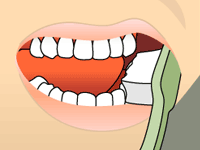
Brushing: Step 1
Place your toothbrush at a 45-degree angle to your gum.
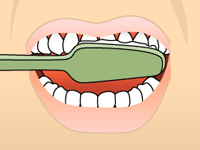
Brushing: Step 2
Brush gently in a circular motion.
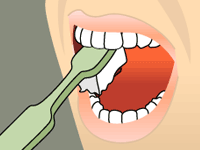
Brushing: Step 3
Brush the outer, inner, and chewing surfaces of each tooth.
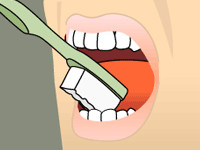
Brushing: Step 4
Use the tip of your brush for the inner surface of your front teeth.
- Flossing Instructions
-
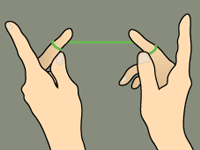
Flossing: Step 1
Wind about 18 inches of floss around your fingers as shown. Most of it should be wrapped around one finger, and the other finger takes it up as the floss is used.
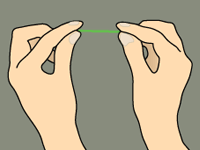
Flossing: Step 2
Use your thumbs and forefingers to guide about one inch of floss between your teeth.
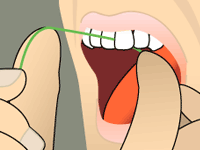
Flossing: Step 3
Holding the floss tightly, gently saw it between your teeth. Then curve the floss into a C-shape against one tooth and gently slide it beneath your gums.
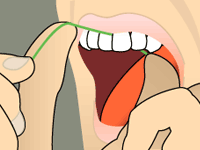
Flossing: Step 4
Slide the floss up and down, repeating for each tooth.